Désirs/Désordres
05.03 – 18.04.26
In her first solo exhibition in Spain in almost a decade, Albarrán Bourdais presents Désirs/Désordres, a show by French artist Annette Messager bringing together works produced between 1989 and 2024. The exhibition proposes a transversal reading of her practice, placing historical works in dialogue with recent pieces that reveal the persistence of certain formal and conceptual concerns: the body as symbolic territory, desire as an ambivalent force, and fragility as a critical strategy.
The title Désirs/Désordres —which translates into English as Desires/Disorders— encapsulates a central tension in Messager’s work: the coexistence of impulse and restraint, eroticism and disturbance, affection and latent violence. From her textile investigations of the late 1980s to recent works such as “Trouble-Doute” (2024) and “Eros” (2024), the artist has developed a visual vocabulary in which the body, desire, and memory become territories of symbolic experimentation.
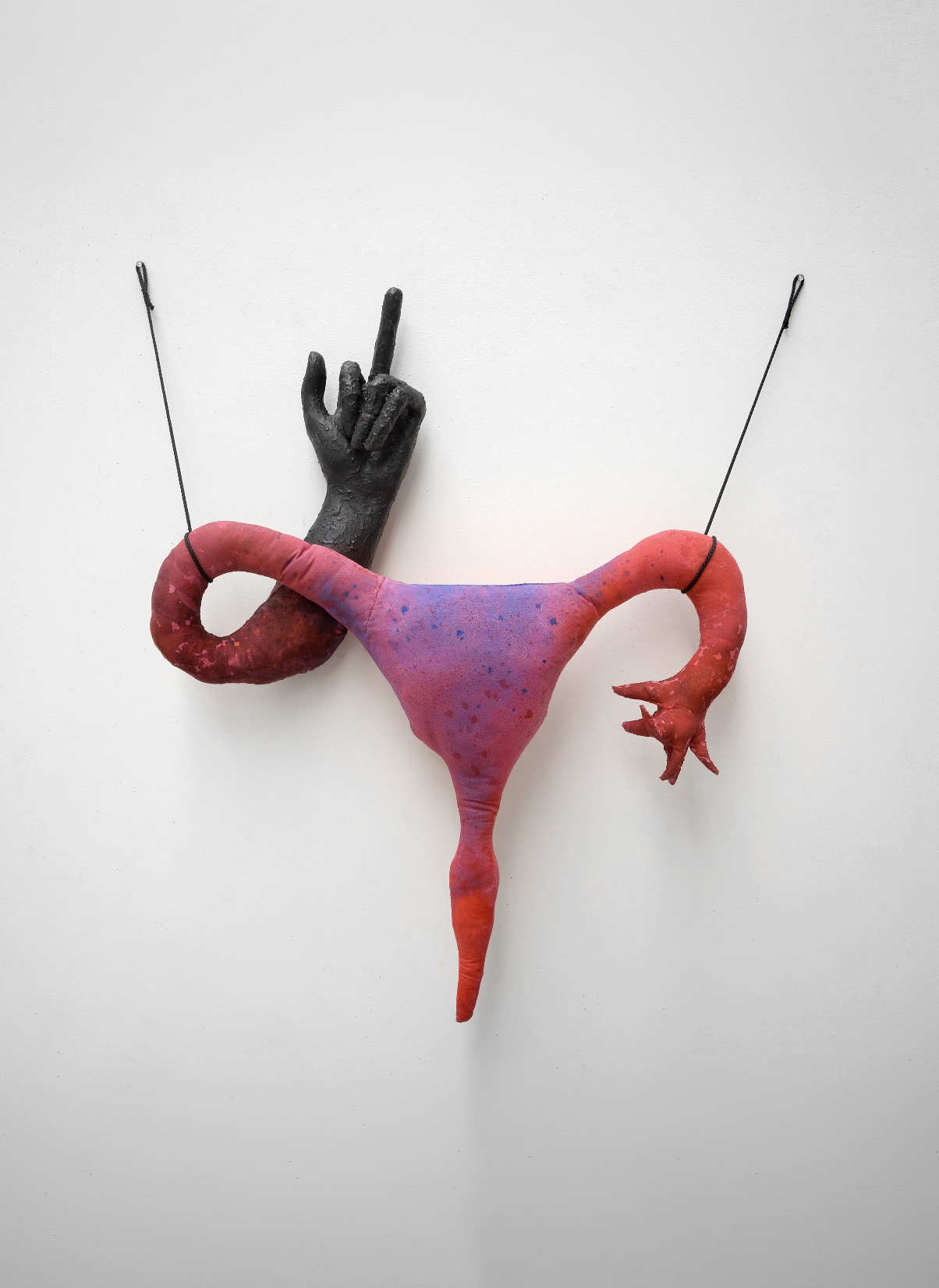
Throughout the exhibition, the female body appears repeatedly fragmented, displaced, or metamorphosed. Works such as “Mains-Utérus” (2016) and “La robe entrailles” (2021) transform corporeality into an ambiguous scene where desire and disorder intertwine, suggesting both potency and vulnerability. Far from presenting a stable or idealized representation, the body in Messager’s work is mutable, expressive, and deeply political.
Sensuality and sexuality run through the exhibition as a latent energy — never illustrative, yet intensely symbolic. The uterus, entrails, and hands emerge as recurring motifs oscillating between the erotic and the unsettling. Rather than monumentalizing the body, Messager presents it as a vulnerable and desiring territory, shaped by impulses, affects, and tensions that challenge normative constructions of gender and representation.
Nets —filets, meshes, threads— constitute a fundamental and recurring element in her practice, functioning both as physical structures and conceptual metaphors. Since the late 1960s, Messager has used fishing nets, cords, and open weaves to support, envelop, or suspend bodily fragments, stuffed animals, drawings, or photographs.
The net does not merely organize space: it captures, protects, exposes, and connects. In Désirs/Désordres, these woven structures generate a simultaneous sense of containment and instability, reinforcing the tension between desire and disorder that gives the exhibition its title.
The textile dimension, central to her trajectory, operates not simply as a reference to craft tradition but as a gesture of insistence and repair. Thread and embroidery function as a form of soft writing that subverts notions of monumentality and permanence. In contrast to the rigid hierarchies of art history, Messager proposes an aesthetic of flexibility, instability, and affect.
In her works, the use of everyday objects —reused materials, garments, nets, stuffed animals, and elements associated with the domestic sphere— allows her to alter their meanings and the emotions attached to them. Avoiding the so-called “noble materials” prescribed by tradition becomes a way of materializing an alternative way of thinking, speaking, and making. As a result, the selection of everyday objects and elements from the domestic landscape shifts grand narratives toward lived experience, toward individual existence and its needs, desires, concerns, and affections.
Throughout Désirs/Désordres, reality and fantasy coexist within a universe where the intimate is never purely private. The artist unsettles material hierarchies and dismantles oppositions between art and craft, high culture and the domestic sphere. Humor, irony, and a persistent unease run through the works, generating an experience that is both sensorial and critical.
With an internationally recognized career —including a retrospective at the Centre Pompidou and the Golden Lion at the 51st Venice Biennale in 2005 representing France— Messager has developed a practice that has decisively influenced subsequent generations of artists.