What does it mean to live a Finite, Fragile Life in an Infinite Eternal Universe
31.10 – 31.12, 2026
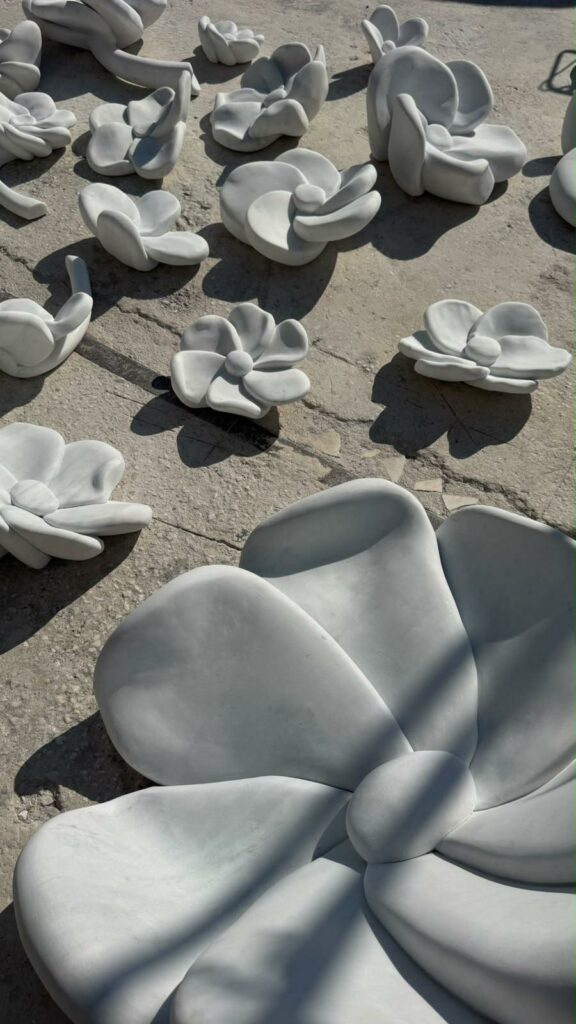
For her second solo exhibition at Albarrán Bourdais, titled What does it mean to live a Finite, Fragile Life in an Infinite Eternal Universe, Claudia Comte presents a new body of Carrara marble sculptures within a site-specific installation conceived for the gallery. Spanning its different levels, the exhibition brings together sculpture and an immersive floor installation to create a continuous environment in which the works unfold throughout the space.
A flower blooms for a moment. Marble remembers millions of years.
Comte’s second solo exhibition at Albarrán Bourdais begins somewhere between two scales. One is fleeting and seasonal, the other geological and measured in deep time. One is intimate, the other immeasurable. At its centre is a simple contradiction. The flower, an image of life, beauty and transience, is transformed into stone, becoming something that appears to resist the very condition it represents.
The show unfolds as a landscape. The floors of the gallery are covered in a continuous swamp pattern, connecting them into a single environment. One enters the landscape in different dimensions rather simply watching it from afar.
Perhaps this is how we encounter any landscape: in fragments.
An insect moving through a garden does not experience the garden as a whole. It encounters a leaf, a shadow, a stem, a patch of earth. The larger world exists around it without ever becoming fully visible. We are not so different. From the scale of the human body, the garden is immense; from the scale of the planet, the garden is almost nothing; from the scale of the universe, the planet itself becomes a fragment.
Comte’s marble sculptures move between these scales. Some are small and almost intimate, while others become monumental. They emerge from walls or stand freely in space, their forms expanding beyond the proportions we expect from a flower. Their apparent delicacy is contradicted by their weight. A blossom becomes hundreds of kilograms of stone. Something associated with fragility acquires mass.
Marble is ancient. It belongs to a time before human memory, before human history, before human presence. The flower belongs to another rhythm entirely – Growth, flowering, decay. To place them together is to bring incompatible durations into the same body. And yet, at another scale, there is no contradiction. The atoms that make up a human body, a flower and a piece of marble are part of the same universe. Matter moves between forms. What appears permanent is changing; what appears insignificant contains histories older than we can imagine. We experience ourselves as separate things, but at another scale everything is continuous.
The floor becomes a kind of living ground: a place of growth, decay and regeneration. Swamps hold matter in transition. Things accumulate, decompose, transform and begin again.
The landscape therefore exists somewhere between the organic and the artificial, between nature and its representation. Comte’s forms are neither attempts to imitate nature nor simulations of it. They are propositions about what happens when nature passes through human perception and technology. When a living form becomes an image, an image becomes data, and data becomes stone.
For a moment, the gallery becomes an ecosystem in which different kinds of time coexist: geological time, biological time, human time and technological time.
Perhaps this is part of what it means to live a finite, fragile life in an infinite, eternal universe: to occupy a tiny space within something we can never see in its entirety, while being made from the very matter of that greater whole.
Our lives may be brief. Our scale may be small. But small does not mean separate. The stone will outlast the flower. The flower will outlast the moment in which we see it. And the atoms that compose them will continue to move through other forms long after we are gone.
The question is not only how long something lasts, but what happens while it is here.
The landscape is changing now.
The title of Claudia Comte’s solo exhibition comes from a question posed by physicist Brian Cox at the beginning of his live talks What does it mean to live a finite, fragile life in an infinite, eternal universe? For Cox, the question opens onto the fundamental strangeness of our existence: we are tiny in relation to the scale of the cosmos, yet we are made from the same matter as it. We are, quite literally, part of the universe we are trying to comprehend. Comte approaches this paradox not through astronomy, but through another way of thinking about scale: the landscape.