Julio Le Parc: Light. Colour. Action.
June 11, 2026 – May 3, 2027
The exhibition, presented at Tate Modern, brings together more than sixty works by Julio Le Parc, tracing the breadth of an artistic practice that has fundamentally transformed the relationship between artwork, space, light, and spectator. Developed in close collaboration with the artist and his Atelier, the exhibition spans over seven decades of production, presenting a wide range of paintings, kinetic sculptures, immersive installations, and participatory environments that reveal the remarkable consistency and experimental vitality of Le Parc’s work from the late 1950s to the present day.
Conceived as a labyrinthine journey through shifting perceptual situations, the exhibition unfolds as an environment in constant transformation. Rather than presenting a chronological survey, the project invites visitors to experience the central concerns that have animated Le Parc’s practice throughout his career. Optical instability, movement, light, participation, and sensory engagement emerge as interconnected elements within a broader investigation into perception and the active role of the viewer. The exhibition proposes an encounter in which seeing becomes a dynamic process, continually shaped by movement, attention, and physical presence.
At the heart of Le Parc’s artistic project lies a sustained critique of passive spectatorship. Since the beginning of his career, the artist has sought to challenge conventional relationships between artwork and audience by creating situations in which viewers become active participants in the construction of meaning. Rather than presenting fixed images to be contemplated from a distance, his works operate as open systems whose visual effects are completed through the perceptual and bodily engagement of those who encounter them. The spectator is no longer positioned as a detached observer but becomes an essential component in the activation of the work itself.
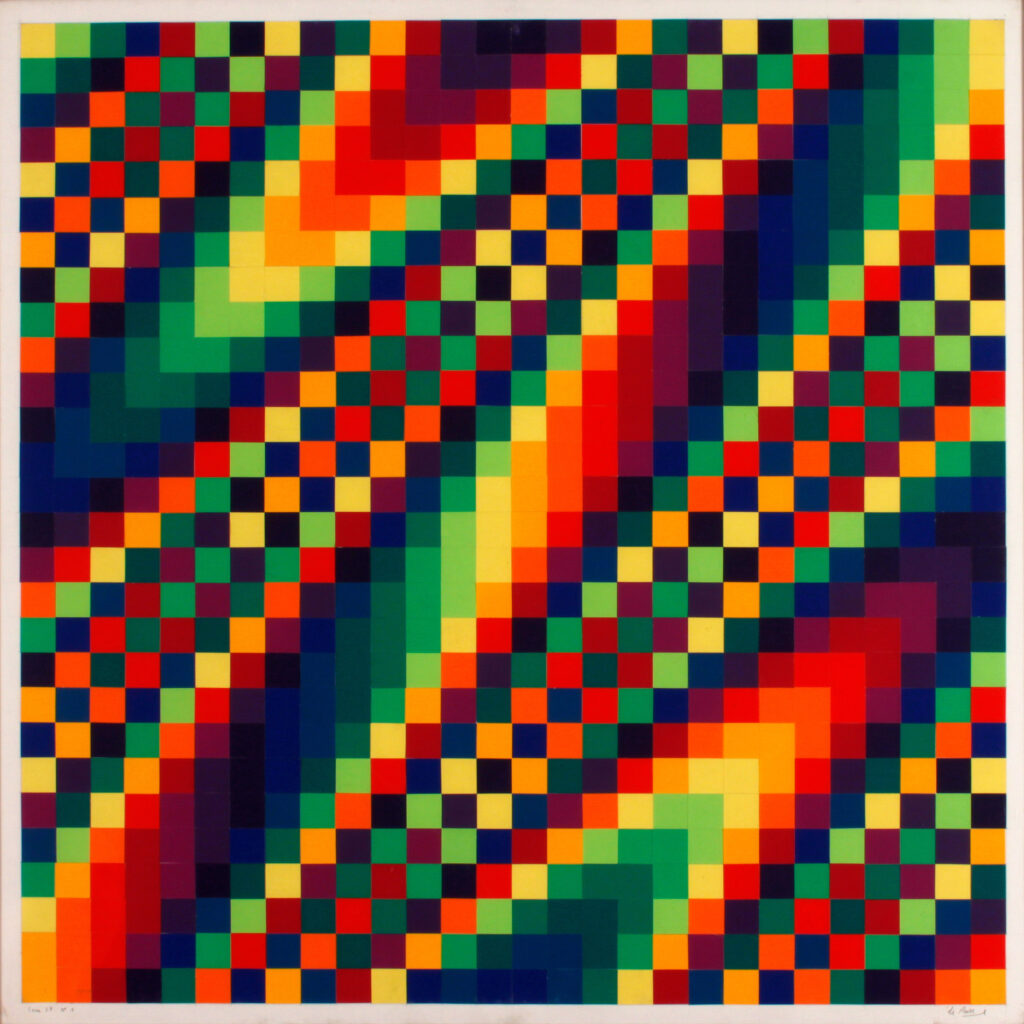
This concern first emerged in the years following Le Parc’s arrival in Paris in 1958. Having studied at the Escuela de Bellas Artes in Buenos Aires before joining the vibrant artistic milieu of post-war Paris, the artist quickly developed a visual language grounded in geometry, seriality, and experimentation. The exhibition opens with works from the Surfaces series and related gouaches and paintings produced during this formative period. Constructed through the repetition of simple geometric units and governed by systematic procedures, these works generate subtle optical disturbances that destabilise visual perception. Shapes appear to vibrate, rotate, dissolve, or shift before the viewer’s eyes, producing a sense of movement that emerges not from the object itself but from the act of looking.
A central aspect of these early investigations concerns the physiological processes of vision. Le Parc became particularly interested in retinal persistence and afterimage phenomena, exploring how perception continues beyond the immediate encounter with an image. Through high-contrast patterns and carefully calibrated visual structures, the works encourage viewers to become conscious of the mechanisms through which vision operates. Perception is presented not as a neutral or automatic process but as an active and participatory event, shaped by the interaction between the body and its environment.
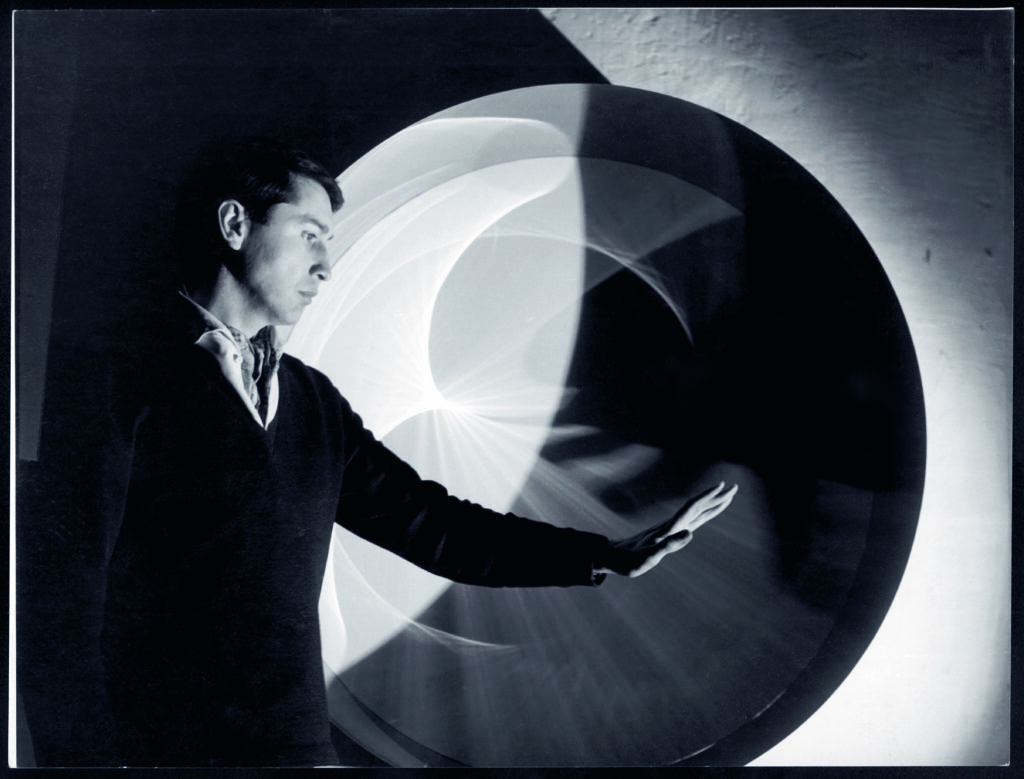
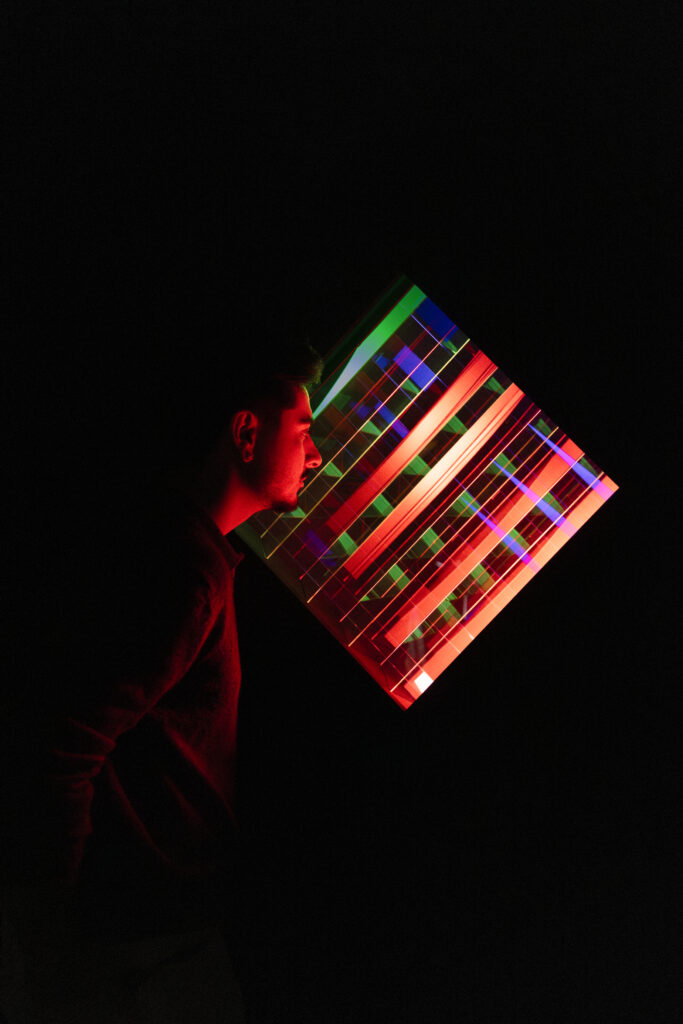
These explorations reached a new level of complexity through Le Parc’s pioneering luminokinetic works. Beginning with the Light Boxes of 1959, the artist developed a series of experiments that combined artificial light, transparent materials, movement, and reflection to produce continuously changing visual environments. These investigations would soon culminate in the celebrated Continual Light Mobiles, a body of work that became one of the defining contributions of kinetic and optical art during the 1960s. Through the interaction of moving elements, projected light, and reflective surfaces, these works generate ever-changing configurations that resist visual stability and challenge conventional notions of sculptural form.
The exhibition places particular emphasis on the role of movement within these installations. In works such as Continuous Light Mobile (1963), suspended elements respond to subtle air currents generated by visitors as they move through the space. The resulting transformations are neither fully controlled by the artist nor entirely predictable. Instead, the work emerges through a dynamic relationship between object, environment, and audience. Light becomes a material in constant flux, while perception itself is transformed into the primary site of artistic experience.
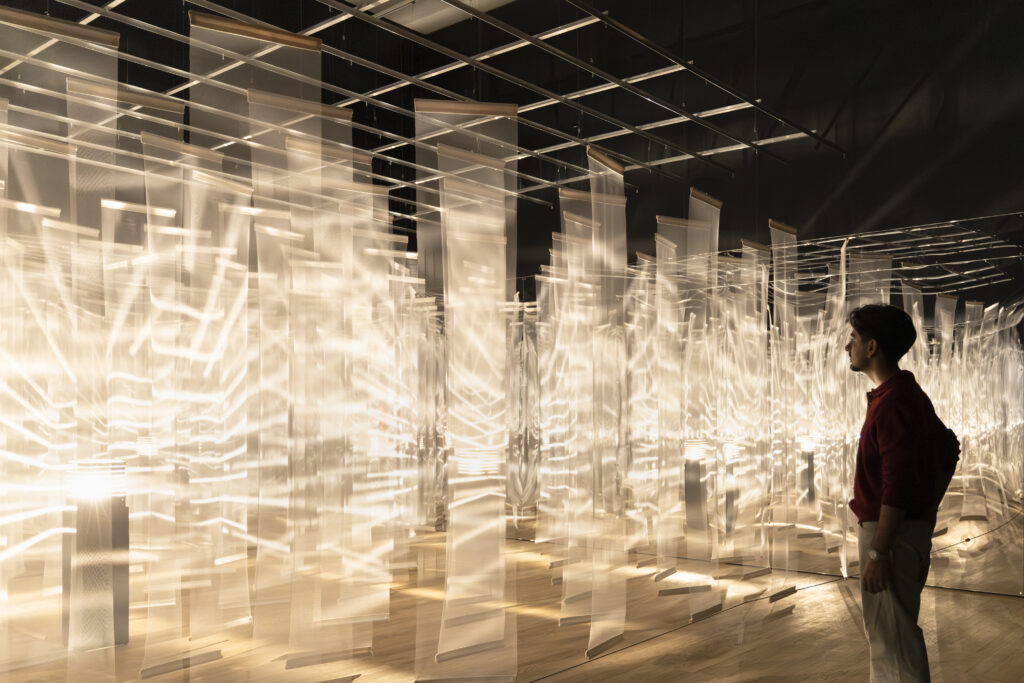
A related line of inquiry unfolds through Le Parc’s immersive environments and large-scale installations. Works such as Unique Continual Light Cylinder (1962) and Vibrating Light – Tulles (1968) extend the artist’s investigations beyond discrete objects into architectural space itself. Light, reflection, transparency, and movement become tools for reshaping spatial perception, dissolving established boundaries between artwork and environment. Visitors are immersed within fields of shifting visual information that continuously alter their awareness of scale, depth, and orientation.
The exhibition further explores Le Parc’s commitment to participation through a number of works that require direct physical engagement. Throughout his career, the artist consistently challenged the idea that artworks should remain untouchable or inaccessible. His participatory environments encourage viewers to manipulate, activate, and transform the works through their own actions. Installations such as the Game Rooms invite forms of play that destabilise traditional hierarchies between artist, object, and audience. Buttons are pressed, elements rotated, mechanisms set in motion. In these situations, participation becomes not merely an educational tool but a critical strategy through which authority is redistributed and creative agency is shared.
Humour and experimentation also occupy an important place within Le Parc’s practice. Many of the participatory works combine rigorous formal systems with playful interactions that encourage curiosity and surprise. By introducing unpredictability into the viewing experience, the artist creates moments of discovery that challenge established expectations about how art should be encountered. This playful dimension remains inseparable from the broader political and social implications of his work, which consistently seeks to empower viewers by making them aware of their own capacity to act, perceive, and intervene.
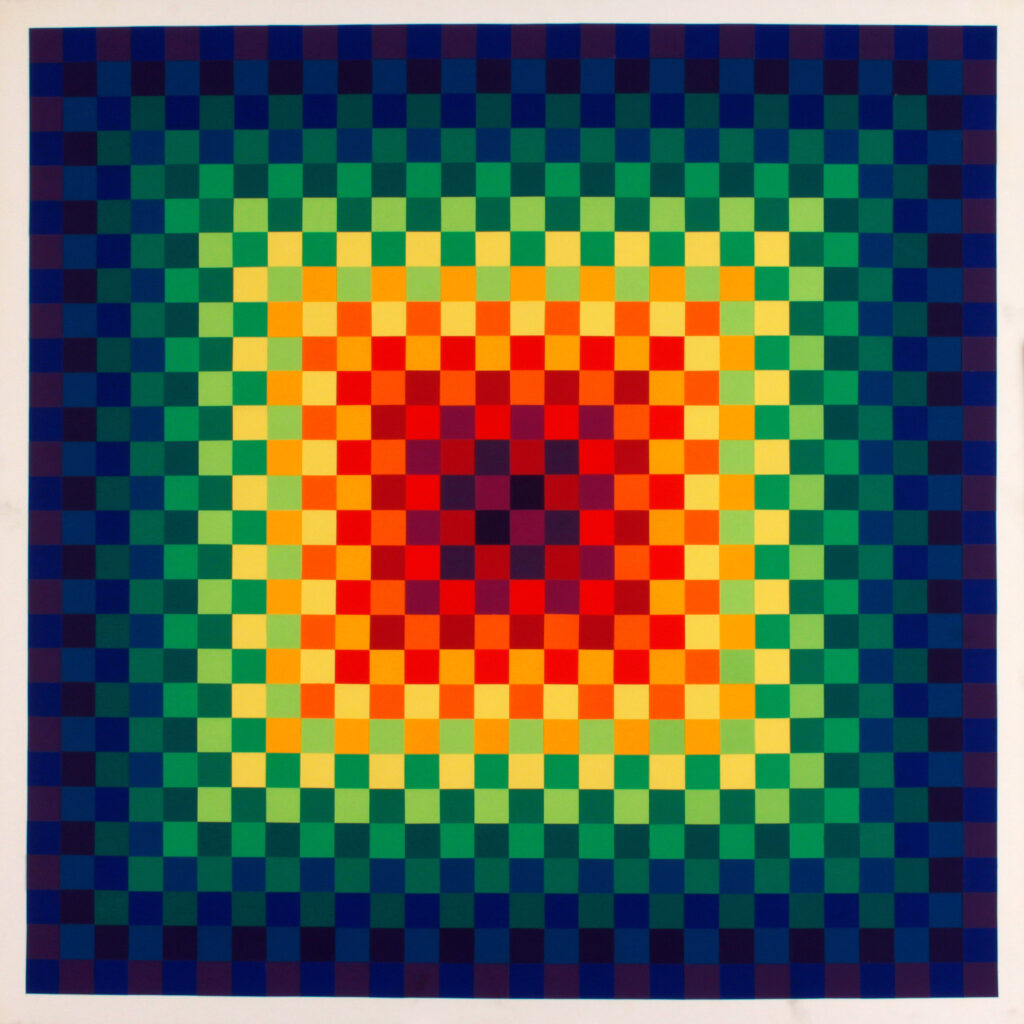
Another fundamental aspect of the exhibition centres on Le Parc’s sustained exploration of colour. While often celebrated for his kinetic and luminous environments, colour has remained a central concern throughout his career. Since developing a distinctive palette of fourteen hues in 1959, the artist has continuously investigated the ways in which colour relationships can generate movement, rhythm, and visual instability. Works produced across different decades reveal an ongoing commitment to systematic experimentation, demonstrating how chromatic structures can activate perception as effectively as light or motion.
This interest is particularly evident in Le Parc’s later paintings, including the celebrated wave compositions and subsequent Modulations and Alchemies series. Here, colour functions not as a static attribute but as a dynamic force capable of generating complex visual experiences. Through subtle shifts, gradients, and repetitions, the paintings produce sensations of movement that seem to unfold across the surface, extending the perceptual concerns of the artist’s earlier kinetic works into two-dimensional form.
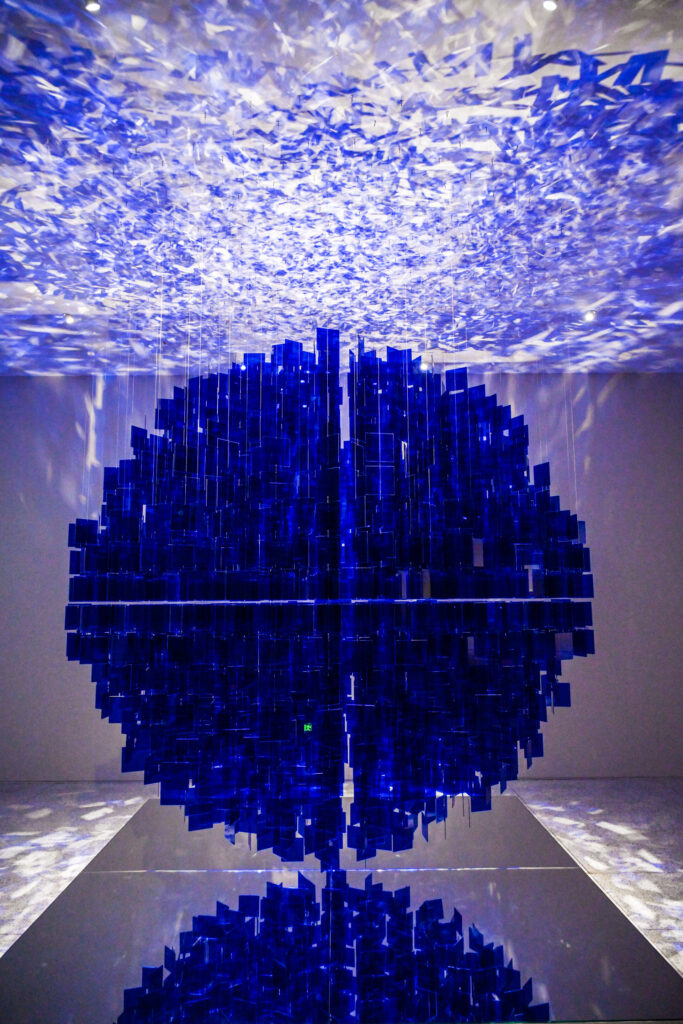
The exhibition concludes with a selection of recent works that demonstrate the continuity of Le Parc’s investigations across more than seventy years of artistic production. Sculptural works such as Blue Sphere (2001–2022) reveal how the artist has continued to revisit and expand earlier concerns with light, movement, reflection, and participation. Far from representing a retrospective conclusion, these works testify to an ongoing process of experimentation in which established ideas remain open to transformation and renewal.
Ultimately, the exhibition invites visitors to reconsider their own role within the act of perception. Through environments shaped by instability, transformation, and sensory engagement, Le Parc proposes a vision of art grounded in participation and openness. In the encounter between light, movement, space, and viewer, the artwork emerges not as a completed form but as a living process—one that continually renews itself through the presence and activity of those who experience it.